
The most common question in the world of investing is also the most dangerous: “Is now the right time to buy?”
It is a question asked by everyone from college students opening their first brokerage account to retirees managing their pension funds. The anxiety behind the question is understandable. You work hard for your money. The last thing you want to do is invest it on a Tuesday, only to watch the market crash on a Wednesday.
We all dream of the perfect scenario: buying a stock at its absolute lowest point (the bottom) and selling it at its absolute highest point (the top).
However, looking for the “perfect” moment is often the reason many potential investors never start at all. They sit on the sidelines, holding cash, waiting for a crash that never comes, while the market marches upward without them.
In this comprehensive guide, we will dismantle the myths of market timing. We will explore the mathematical, psychological, and economic indicators that define a “good” buying opportunity. We will move beyond the crystal ball and give you a data-driven framework to decide when to pull the trigger.
The Myth of “Timing the Market” vs. “Time in the Market”

To understand when to buy, you first need to understand why trying to guess the exact moment is a fool’s errand. This concept is known as Market Timing.
Market timing involves trying to predict future price movements based on news, gut feelings, or technical charts. While it sounds logical, study after study shows that even professional fund managers fail to do this consistently.
The Cost of Waiting
Let’s look at the data. If you invested in the S&P 500 over a 20-year period but you tried to time the market and missed just the 10 best trading days, your returns would be cut in half. If you missed the 20 best days, your returns might be wiped out entirely.
Here is the irony: The “best” days usually happen immediately after the “worst” days.
-
The market crashes 5% on Monday (Panic).
-
The market rallies 6% on Tuesday (Recovery).
If you sold on Monday to “wait for the dust to settle,” you missed the Tuesday rally. By staying invested—or buying consistently—you capture those recovery days. This leads to the golden rule of Wall Street: “Time in the market beats timing the market.”
The Strategy of Dollar-Cost Averaging (DCA)
If we accept that we cannot predict the future, what is the best time to buy? The answer is: Always.
This strategy is called Dollar-Cost Averaging (DCA). It is the single most effective tool for laypeople to build wealth without stress.
How DCA Works
Instead of trying to dump $10,000 into the market at the “perfect” moment, you invest a fixed amount of money at regular intervals, regardless of the price.
-
Example: You invest $500 on the 1st of every month.
The Mathematical Magic
Here is why DCA makes “now” the best time to buy:
-
When the Market is High: Your $500 buys fewer shares. (You avoid overpaying).
-
When the Market is Low: Your $500 buys more shares. (You automatically buy the dip).
-
The Average: Over time, your average cost per share ends up being lower than the average market price.
By using DCA, you stop treating the stock market like a casino and start treating it like a monthly bill. You remove the emotion. You don’t have to ask “is today a good day?” because every day is a buying day in the long run.
Fundamental Valuation: Buying the “Discount”
While DCA is the best strategy for passive investors, active investors often look for “value.” Just like you prefer to buy a winter coat when it is 50% off in July, you should prefer to buy stocks when they are “on sale.”
But how do you know if a stock is on sale? You cannot just look at the price tag. A $10 stock can be expensive, and a $500 stock can be cheap. You must look at Valuation.
The P/E Ratio (Price-to-Earnings)
The most common metric to determine the “best time” to buy is the P/E Ratio. It compares the stock price to the company’s profit.
-
Historical Context: Historically, the S&P 500 trades at a P/E of around 15 to 20.
-
Overvalued: If the market P/E hits 30 (like in the Dot-Com bubble), it is “expensive.” Buying now is risky because future returns might be lower.
-
Undervalued: If the market P/E drops to 12 (like in the 2008 crash), it is “cheap.” This is a screaming buy signal.
The “Buffett Indicator”
Legendary investor Warren Buffett uses a specific metric: Total Market Cap to GDP.
He compares the value of all stocks to the entire economic output of the country. If the stock market is worth much more than the economy (e.g., 150% of GDP), prices are too high. If it falls below (e.g., 70% of GDP), it is a great time to buy.
Buying During a Recession: The “Be Greedy” Principle
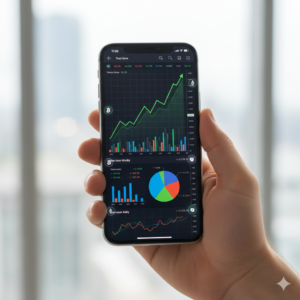
Ideally, the absolute best time to buy stocks is when the news is terrible.
When you see headlines about recession, unemployment, and war, your human instinct is to run away (Sell). However, financial logic dictates you should run toward the fire (Buy).
The Psychology of Fear
Warren Buffett famously said: “Be fearful when others are greedy, and be greedy when others are fearful.”
During a recession or a market crash (Bear Market):
-
Panic sellers drive prices down far below their logical value.
-
High-quality companies (like Apple or Microsoft) go on sale, sometimes dropping 30% or 40% despite still making billions in profit.
-
This is the moment of maximum financial opportunity.
The Recovery Trajectory
Every major crash in history—1929, 1987, 2000, 2008, 2020—has been followed by a recovery to new all-time highs. If you bought during the depths of the 2020 pandemic crash, you likely doubled your money within 18 months. The “best time” usually feels like the “scariest time.”
Intraday and Seasonal Trends: Do They Matter?
If you are a day trader or looking for short-term entry points, you might look at smaller timeframes. While less important for long-term investors, these trends are statistically interesting.
The “Best” Time of Day
Data suggests that the market is most volatile in the first hour (9:30 AM – 10:30 AM EST) and the last hour (3:00 PM – 4:00 PM EST).
-
Morning: This is when the market reacts to overnight news. Prices often swing wildly. It is usually better to wait until 11:00 AM for the volatility to settle before placing a trade.
The “Best” Month of the Year
There is an old adage: “Sell in May and go away.”
Historically, the summer months (June, July, August) have lower trading volumes and lower returns. The market often picks up steam in November and December (the so-called “Santa Claus Rally”) due to holiday spending and end-of-year portfolio adjustments.
-
The September Effect: Statistically, September is often the worst performing month for stocks. For a buyer, this means September is often a great month to go shopping for bargains.
Lump Sum vs. DCA: What if You Have a Pile of Cash?
Here is a common scenario: You inherit $50,000, or you get a large work bonus.
Should you invest it all today (Lump Sum), or split it up over 12 months (DCA)?
The Math Says: Lump Sum
Vanguard conducted a massive study and found that Lump Sum investing beats DCA about 66% of the time.
Why? Because the market goes up more often than it goes down. By waiting, you are usually just watching the price get higher.
The Psychology Says: DCA
However, investing is not just math; it is emotion.
If you invest $50,000 today, and the market drops 10% tomorrow, you will feel sick. You will regret it.
If you split that $50,000 into 10 payments of $5,000, and the market drops, you feel smart because you get to buy cheaper next month.
Verdict: If you are nervous, use DCA. If you are cold and logical, use Lump Sum.
Macroeconomic Factors: Interest Rates and The Fed

To understand the best buying windows, you must watch the Federal Reserve (The Central Bank). Interest rates act as gravity for stock prices.
The Pivot Point
-
Rising Rates: When the Fed raises rates to fight inflation, stocks usually fall. Borrowing becomes expensive, and corporate profits shrink. (This creates a buying opportunity for long-term holders).
-
Falling Rates: When the Fed starts cutting rates, it is usually “juice” for the market. Stocks tend to rally.
The Smart Move: The best time to buy is often when the Fed stops raising rates (the “Pause”) but before they start cutting them. The market usually rallies in anticipation of the cuts. If you wait until the rates actually drop, you might have missed the first 20% of the rally.
Assessing Personal Readiness: The Real “Right Time”
Forget the charts for a moment. The best time to buy stocks has nothing to do with the S&P 500 and everything to do with your personal bank account. Even if the market is at an all-time low, it is the wrong time to buy if your financial house is not in order.
The Pre-Investment Checklist
Do not buy a single share until you check these three boxes:
-
High-Interest Debt is Gone: If you have credit card debt at 20% APR, paying that off is a guaranteed 20% return. The stock market cannot promise that. Pay the debt first.
-
Emergency Fund is Funded: You need 3 to 6 months of living expenses in cash. If you lose your job during a recession, you do not want to be forced to sell your stocks at the bottom to buy groceries.
-
Time Horizon is 5+ Years: Are you saving for a house down payment needed next year? Do not put that money in stocks. The market could drop 20% next year. Only invest money you do not need to touch for at least 5 to 10 years.
How to Spot a “Market Bottom” (Or Get Close to It)
While we established that timing is impossible, there are signs that a bear market (downturn) is nearing its end. These signs can give you the confidence to deploy extra cash.
1. Capitulation (The “Puke” Point)
A bottom rarely happens when people are just “worried.” It happens when people give up. When you see retail investors selling everything, vowing never to touch stocks again, and news anchors declaring the “Death of Equities,” we are usually close to a bottom.
2. The VIX (Fear Index) Spikes
The VIX Volatility Index measures fear.
-
A VIX below 20 implies calm.
-
A VIX above 40 implies panic.
-
Historically, buying the S&P 500 when the VIX is above 40 has generated incredible returns over the following 2 years.
3. Insider Buying
Corporate executives (CEOs and CFOs) have to report when they buy shares of their own company. They know their business better than anyone. If you see a cluster of CEOs buying their own stock during a market crash, it is a strong signal that they believe the stock is undervalued.
The Best Time Was Yesterday

There is an ancient Chinese proverb that applies perfectly to investing:
“The best time to plant a tree was 20 years ago. The second best time is now.”
If you wait for the “perfect” setup—low P/E ratios, a supportive Federal Reserve, world peace, and a stable economy—you will wait forever. The market climbs a “wall of worry.” There is always a reason not to buy.
The successful investor ignores the noise. They do not look at the calendar. They do not obsess over the daily news. They simply set up an automatic transfer, buy diversified index funds or quality companies, and let the incredible power of compound interest work its magic over decades.
The Verdict:
-
For 99% of people: The best time to buy is today, and then again next month, and the month after that (DCA).
-
For the brave: If the market crashes 20%, double your contribution.
Stop waiting for the green light. The light is green. Start investing today.