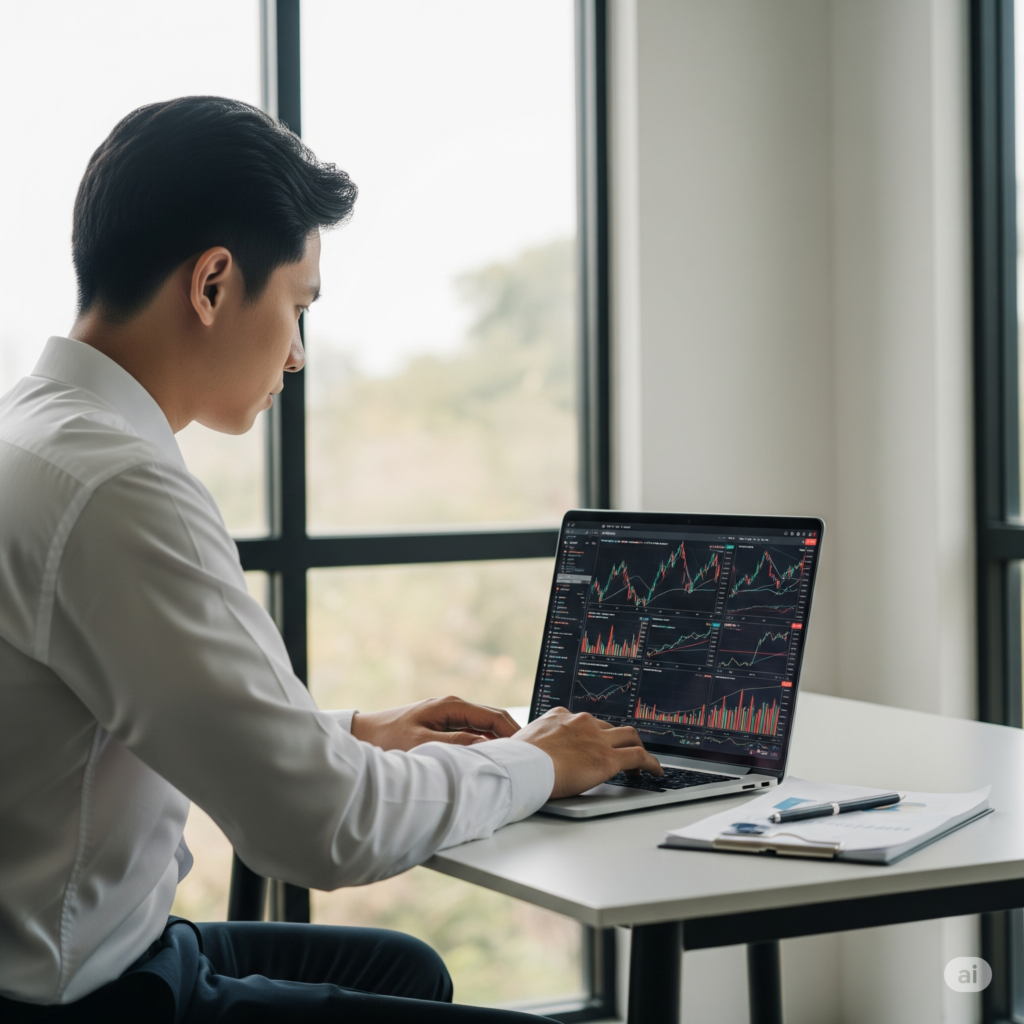
In the digital age, buying a stock feels as simple as ordering a pizza or posting a photo on social media. You open an app, tap a button, and within seconds, you receive a notification that you are now a shareholder of a global corporation. However, beneath that seamless user interface lies one of the most complex, high-speed, and tightly regulated infrastructures ever built by man.
What actually happens between the moment you tap “Buy” and the moment those shares appear in your account? How do thousands of different prices find a consensus? And who are the invisible middlemen ensuring that the transaction is fair and secure?
In this comprehensive guide, we will pull back the curtain on trade execution. We will explore the journey of an order through the digital pipes of Wall Street, the technology that matches buyers with sellers, and the vital post-trade processes that ensure the integrity of the entire financial system.
1. The Lifecycle of a Trade: From Your Smartphone to the Exchange

The journey of a stock trade begins at the Brokerage level. Whether you use a traditional firm or a modern “zero-commission” app, your broker acts as your agent in the marketplace.
Step 1: Order Entry
When you enter an order, you aren’t actually “buying” the stock yet. You are sending an instruction to your broker. This instruction includes the ticker symbol, the number of shares, and the “instruction type” (which we will cover in detail below).
Step 2: Routing
Once the broker receives your order, their “Smart Order Router” (SOR) decides where to send it. Your order doesn’t necessarily go straight to the New York Stock Exchange (NYSE). To find you the best price, the broker might send it to:
-
Public Exchanges: Like the NYSE or NASDAQ.
-
Wholesalers (Market Makers): Large firms that buy and sell stocks from their own inventory.
-
Dark Pools: Private exchanges where large institutional orders are executed away from public view to prevent price volatility.
2. Understanding the Order Book: Where Buyers and Sellers Meet
Every publicly traded stock has an Order Book. Think of this as a digital ledger that is constantly updated in real-time. It lists all the people who want to buy (Bids) and all the people who want to sell (Asks).
The Bid-Ask Spread
-
The Bid: The highest price a buyer is willing to pay.
-
The Ask: The lowest price a seller is willing to accept.
-
The Spread: The difference between these two numbers.
If you want to buy a stock immediately, you pay the “Ask” price. If you want to sell immediately, you accept the “Bid” price. The spread is essentially a “transaction cost” that goes to the market makers who provide the liquidity to keep the book balanced. For highly liquid stocks like Apple or Tesla, the spread is often just a penny. For obscure, low-volume stocks, the spread can be quite wide, making it much more expensive to trade.
3. Market Orders vs. Limit Orders: Which Execution Strategy is Best?
How your trade is executed depends heavily on the Order Type you choose. This is the most critical decision a retail investor makes during the execution process.
The Market Order
A market order tells the broker: “Buy this stock right now at whatever the best available price is.”
-
Pros: Guaranteed execution. You will get your shares almost instantly.
-
Cons: No price protection. In a volatile market, the price could jump a few percentage points in the millisecond between you clicking “Buy” and the trade executing. This is known as Slippage.
The Limit Order
A limit order tells the broker: “Only buy this stock if the price is $100 or less.”
-
Pros: Price certainty. You will never pay more than your limit.
-
Cons: No guarantee of execution. If the stock price stays at $101 all day, your order will sit unfilled, and you may miss the opportunity to buy.
Stop Orders (The Safety Net)
Stop orders are used to protect profits or limit losses. A “Stop-Loss” order becomes a market order once a certain price level is hit. These are vital for risk management but can be dangerous during “flash crashes” where the price drops and recovers in seconds.
4. The Role of the Matching Engine: The Digital Heart of Wall Street

At the center of every stock exchange is a Matching Engine. This is an incredibly powerful computer system that uses a specific set of rules to pair buyers with sellers.
The Price-Time Priority Rule
Most major exchanges operate on a “Price-Time Priority” basis.
-
Price: The best price always gets filled first. If you offer to pay $50.01 for a stock and someone else offers $50.00, your order moves to the front of the line.
-
Time: If two people offer the same price, the person who placed their order first gets filled first.
This is why speed is so important in modern finance. Large firms spend millions of dollars to place their servers as physically close to the exchange’s matching engine as possible (a practice called “Colocation”) to gain a microsecond advantage in the time priority queue.
5. Behind the Scenes: The Clearing and Settlement Process
A common misconception is that when your app says “Trade Executed,” the transaction is finished. In reality, that is just the “Trade Date” (T). The actual transfer of ownership and cash happens in the “back office” through a process called Clearing and Settlement.
The Role of the Clearinghouse
In the United States, the National Securities Clearing Corporation (NSCC) and the Depository Trust Company (DTC) act as the central middlemen. They ensure that the seller actually has the shares and the buyer actually has the money.
T+1 Settlement
Historically, it took three days (T+3) to settle a trade. As technology improved, it moved to T+2. As of May 2024, the U.S. market moved to T+1 settlement. This means that when you buy a stock on Monday, the official legal change of ownership and the final movement of funds happen on Tuesday. This reduction in time reduces risk in the financial system and allows investors to access their cash faster.
6. Payment for Order Flow (PFOF): How “Free” Trading Actually Works
If your broker doesn’t charge you a commission, how do they make money? For many retail brokers, the answer is Payment for Order Flow.
Instead of sending your order directly to the NYSE, the broker “sells” your order to a high-frequency trading firm (a Wholesaler). The wholesaler pays the broker a small fee (pennies per share) for the right to execute your trade.
-
Why Wholesalers Do This: They profit from the Bid-Ask spread and use the data from retail “noise” to balance their own massive portfolios.
-
The Controversy: Critics argue this creates a conflict of interest, where brokers might not be seeking the absolute “best” execution for you, but rather the one that pays them the most. However, regulators require brokers to provide “Best Execution,” meaning the price you get must be at least as good as the best price available on the public exchanges.
7. Dark Pools and High-Frequency Trading: The Hidden Side of Execution
Not all trading happens in the light. Dark Pools are private exchanges operated by large banks (like Goldman Sachs or JP Morgan).
Why Dark Pools Exist
If a massive pension fund wants to sell 5 million shares of a stock, doing so on a public exchange would cause the price to plummet instantly as other traders see the massive “Sell” order. In a Dark Pool, the fund can sell those shares quietly to other institutional buyers without the public seeing the order until after it is executed. This prevents “market impact” and saves the fund (and its retirees) millions of dollars.
High-Frequency Trading (HFT)
HFT firms use complex algorithms to trade in and out of positions in milliseconds. While they are often blamed for volatility, they provide the vast majority of the Liquidity in the modern market. Without them, the Bid-Ask spreads would be wider, and it would be much harder for the average person to buy or sell stocks instantly.
8. The Impact of Latency and Technology on Trade Execution

In the 1980s, trades were executed by humans shouting on a floor. Execution took minutes. Today, it takes Microseconds ($1/1,000,000$th of a second).
This speed is made possible by fiber-optic cables, microwave towers, and high-performance hardware. However, this has introduced a new risk: Latency. Latency is the delay between a command and the execution.
For a retail investor, a latency of 100 milliseconds is unnoticeable. For an HFT bot, 100 milliseconds is an eternity. This technological arms race has made markets more efficient but has also led to “Flash Crashes,” where algorithms interact in unexpected ways, causing the market to drop and recover before a human can even blink.
9. Common Execution Risks and How to Mitigate Them
Even with the best technology, things can go wrong. Understanding these risks can save you from costly mistakes.
-
Slippage: This happens most often in “Fast Markets” (high volatility). To avoid it, use Limit Orders.
-
Partial Fills: If you want to buy 1,000 shares but there are only 500 available at your limit price, you will get a “Partial Fill.” You may have to pay a second commission (if your broker still charges them) or adjust your price to get the rest.
-
Gapping: This occurs when a stock closes at one price (e.g., $100) and opens the next morning at a completely different price (e.g., $90). If you had a stop-loss at $95, it would trigger at $90, the first available price.
-
Busted Trades: Rarely, an exchange will “bust” or cancel trades if there was a major technical error or a clear case of “erroneous execution.”
10. Navigating the Digital Arena
Execution is the “last mile” of investing. You can have the best research and the perfect strategy, but if you don’t understand how your trades are executed, you are leaving money on the table.
By understanding the role of Limit Orders, the importance of the Bid-Ask Spread, and the reality of T+1 Settlement, you move from being a “user” of an app to a true participant in the global financial system. The stock market is a high-speed digital arena—knowledge of its mechanics is your best defense and your greatest advantage.
As technology continues to evolve—with blockchain and AI-driven execution on the horizon—the process will only get faster. Stay informed, stay disciplined, and always respect the “pipes” that make modern wealth creation possible.