It is one of the most confusing sights in the financial world: the stock market hitting all-time highs while the evening news reports rising unemployment, shuttered businesses, and a slowing economy. For the casual observer, this seems not only illogical but almost offensive. How can “Wall Street” thrive while “Main Street” struggles?
The answer lies in a fundamental truth about financial markets: The stock market is a leading indicator, whereas economic data is a lagging indicator.
To navigate the world of investments, loans, and business strategy, you must understand that the market lives in the future, while the economy lives in the past. In this guide, we will break down the mechanics of why the stock market moves months ahead of economic reality and how you can use this knowledge to become a more disciplined investor.
1. The Stock Market as a Forward-Looking Discounting Mechanism
At its core, the stock market is a “discounting mechanism.” This means that the price of a stock today is not a reflection of how a company performed last year or even how it is performing this morning. Instead, it is the market’s best guess as to how much profit that company will generate over the next several years.
The Present Value of Future Earnings
Investors use a concept called Discounted Cash Flow (DCF) to value a company. In simple terms, they try to determine the “Present Value” (PV) of all future cash the company will ever make.
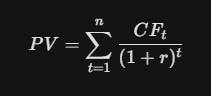
In this formula:
-
CF_t represents the cash flow at a specific time in the future.
-
r is the discount rate (often influenced by interest rates).
-
n is the time horizon.
Because CF represents future money, stock prices move the moment investors expect a change in that future money. If investors believe a recession will end in six months, they will start buying stocks today to “discount” the recovery before it actually happens. By the time the GDP (Gross Domestic Product) officially shows growth, the “easy money” in the stock market has often already been made.
2. Why Economic Data is Always a Lagging Indicator
If the stock market is a crystal ball, economic reports are a rearview mirror. Most of the data that the government releases—GDP, Unemployment Rates, and the Consumer Price Index (CPI)—describes events that have already occurred.
The Delay in Data Collection
Consider the Unemployment Rate. For a person to be counted as unemployed, they must first lose their job, wait for the survey period, and then have that data processed by the Bureau of Labor Statistics. By the time the “high unemployment” headline hits your phone, the company that laid them off might have already started planning for its next growth phase.
GDP: The Ultimate Lag
GDP is reported quarterly and is often revised months later. By the time we have a “final” GDP number for the first quarter of the year, we are already well into the second or third quarter. Investors cannot wait for these reports to make decisions; if they did, they would always be late to the party.
Instead, professional traders look at “High-Frequency Data,” such as credit card spending, electricity usage, and satellite imagery of retail parking lots, to guess what the GDP will be before it is announced.
3. The Role of the Federal Reserve and Monetary Policy
One of the primary reasons the market moves before the economy is Monetary Policy. Central banks, like the Federal Reserve, use interest rates to steer the economic ship. However, an interest rate change is not an instant fix; it usually takes 6 to 18 months for a rate cut to fully circulate through the “real” economy.
Anticipating the “Pivot”
The stock market reacts to interest rate changes almost instantly.
-
The Signal: The Fed suggests they might stop raising rates.
-
The Market Reaction: Stock prices jump immediately because they know borrowing will become cheaper in the future.
-
The Economic Reality: A year later, a small business finally takes out a low-interest loan to hire a new employee.
Because the market anticipates these “pivots” in policy, the stock indices often rally while interest rates are still technically high and the economy still feels “tight.”
4. Institutional Intelligence vs. Retail Perception
There is a significant “Information Asymmetry” between large institutional investors (hedge funds, pension funds, investment banks) and the general public.
How the “Smart Money” Operates
Institutional investors spend millions of dollars on proprietary research. They employ teams of economists and data scientists to build models that predict economic shifts. When these large players see a recovery on the horizon, they begin “accumulating” stocks quietly.
This accumulation phase often happens when the news is at its bleakest. To the average person watching the news, the world looks like it is falling apart. To the institutional investor, the world looks “cheap.” This buying pressure pushes prices up, causing the market to move higher even as the public remains fearful.
5. The “Wealth Effect” and Its Impact on Future Spending

Interestingly, the stock market doesn’t just reflect the future economy; it can actually help create it. This is known as the Wealth Effect.
When the stock market begins to recover, individuals with retirement accounts, 401(k)s, and personal portfolios see their balances rise. Even if they don’t sell their stocks, they feel wealthier. This psychological boost leads to:
-
Increased Consumer Spending: People are more likely to buy a new car or renovate a home when their portfolio is “in the green.”
-
Business Confidence: CEOs of public companies, whose compensation is often tied to stock price, feel more confident to invest in new equipment when their stock is performing well.
In this way, the stock market’s early move acts as a “self-fulfilling prophecy” that eventually drags the real economy upward behind it.
6. Historical Examples: When the Market Got It Right
History is full of examples where the stock market “yelled” that a recovery was coming while the economy was still in the basement.
-
The Great Recession (2009): The U.S. stock market bottomed out in March 2009. At that time, banks were still failing, and the unemployment rate was still climbing (it wouldn’t peak until October 2009). Investors who waited for the “good news” in the labor market missed a massive 50% rally in stocks.
-
The COVID-19 Pandemic (2020): The market crashed in March 2020 as the world locked down. However, the market began a historic rally in April 2020, even though millions of people were still being laid off and vaccines were still months away. The market was looking forward to government stimulus and an eventual reopening, ignoring the grim reality of the present.
7. The Composition Gap: The S&P 500 is Not the Economy
A crucial reason for the “disconnect” is that the stock market is not a perfect representation of the total economy.
Large-Cap Dominance
The S&P 500 is composed of the 500 largest publicly traded companies. These companies often have:
-
Global Diversification: They make money all over the world, not just in your local town.
-
Efficiency: They can cut costs and use technology to stay profitable even when the average small business is struggling.
-
Access to Capital: Large corporations can issue bonds to survive a downturn, whereas a local restaurant might simply run out of cash.
Therefore, the “market” can be healthy because 500 giant companies are doing well, even if 500,000 small businesses are suffering.
8. Managing the Risk of “Market Noise”

While the market is usually right about the future, it is not perfect. Sometimes the market experiences a “False Start”—rising on the hope of a recovery that doesn’t arrive. This is often called a “Bear Market Rally.”
How to Stay Grounded:
-
Don’t Chase the Headlines: By the time you read a “Good News” headline, it is likely already priced into the stock.
-
Focus on Trends, Not Days: Look at the moving averages of the market rather than the daily price swings.
-
Understand Your Time Horizon: If the market moves 10% before the economy, but you aren’t retiring for 20 years, the “gap” between the two doesn’t matter as much as your consistency.
9. Embracing the “Forward-Looking” Mindset
To be a successful investor, you must learn to be “comfortable being uncomfortable.” The best time to invest is often when the economic data looks the worst, because that is when the stock market has already priced in the “bad news” and is looking for a reason to go higher.
The stock market moves before the economy because it is a collection of millions of people making bets on the future. It is a massive, real-time voting machine that prioritizes “what’s next” over “what’s now.” By recognizing that data is a reflection of the past and stock prices are a reflection of the future, you can avoid the trap of waiting for “certainty” before you put your money to work.