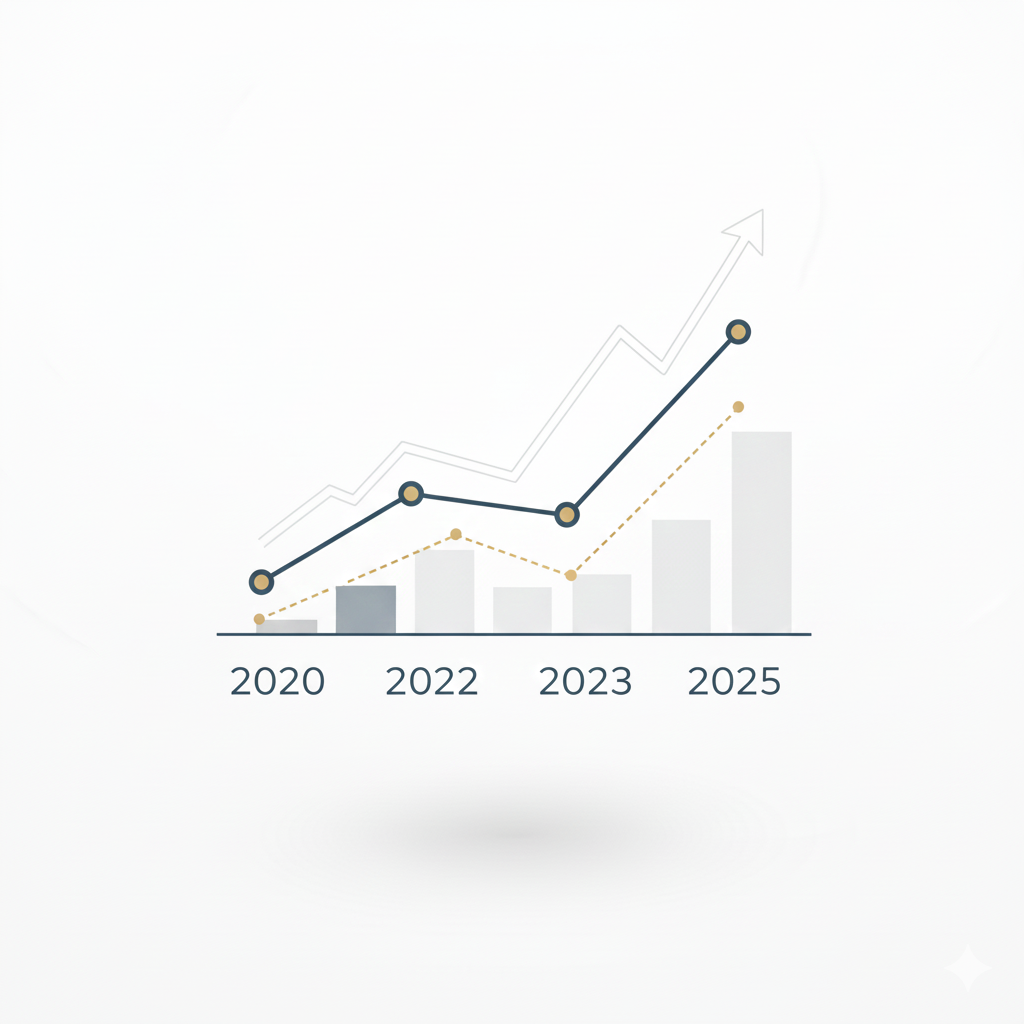
We live in a data-driven world. We track our steps with smartwatches, we track our calories with apps, and we track our sleep cycles to optimize rest. Yet, when it comes to the most impactful area of our lives—our money—most people rely on a single, flawed metric: The checking account balance.
Checking your bank balance tells you how much money you have right now, but it tells you absolutely nothing about where you are going. It is like looking at the speedometer of a car without looking at the map. You might be moving fast, but are you moving in the right direction?
Many high-income earners feel stuck on a “financial hamster wheel.” They earn more money every year, yet they don’t feel any wealthier. This happens because they lack a system to measure their Financial Evolution.
True financial progress isn’t just about having more cash; it is about increasing efficiency, reducing liability, and building momentum. To truly understand your financial health, you need to track the right Key Performance Indicators (KPIs).
In this extensive guide, we will move beyond the basics. We will explore the sophisticated metrics used by wealth managers and financial planners, simplified for everyday application. By the end of this article, you will have a comprehensive dashboard to visualize your journey from financial insecurity to total financial independence.
The North Star Metric: Why Net Worth Trumps Income Every Time

If you only track one number for the rest of your life, make it your Net Worth.
Society is obsessed with income. We ask, “How much does he make?” or “What is the salary for that job?” But income is merely a stream of water. Net worth is the reservoir. You can have a massive stream (high income) but a reservoir full of cracks (high spending and debt), leaving you with nothing.
How to Calculate It Properly
The formula is deceptively simple: Assets – Liabilities = Net Worth.
However, to measure evolution, you must be consistent in how you value things.
-
Liquid Assets: Cash, savings, brokerage accounts. These are easy to track.
-
Illiquid Assets: Real estate and vehicles. Be careful here. Do not overestimate the value of your home. Use conservative estimates (like Zillow’s lower range or recent neighborhood sales). For cars, always account for depreciation. A car is a depreciating asset; its value drops every month.
-
Liabilities: This is everything you owe. Mortgage, credit cards, student loans, and that personal loan you took out for the vacation.
The Trend Line
A single net worth number is a snapshot. The evolution is found in the trend line.
-
The Goal: You want a chart that moves up and to the right.
-
The Reality: It will be jagged. The stock market will dip, or you might buy a house (which converts liquid cash into illiquid equity). Do not panic over monthly fluctuations. Look at the Year-Over-Year (YoY) change. If your Net Worth is higher this December than it was last December, you are evolving.
The Efficiency Metric: Tracking Your Personal Savings Rate

You earned $100,000 this year. That is impressive. But if you spent $100,000, your financial progress was exactly zero.
Your Savings Rate is the most important determinant of how quickly you will reach financial freedom. It measures the gap between your income and your ego.
The Math of Freedom
-
Formula: (Total Savings / Gross Income) x 100.
-
Example: You earn $5,000 a month. You save $1,000. Your savings rate is 20%.
Why This Metric Matters More Than Returns
Many people obsess over getting a 10% return in the stock market versus an 8% return. While returns matter, early in your journey, your savings rate does the heavy lifting.
If you increase your savings rate from 10% to 20%, you effectively cut your working years in half.
Measuring Evolution:
-
Beginner: 5% to 10% savings rate.
-
Intermediate: 15% to 25% savings rate.
-
Advanced (FIRE – Financial Independence, Retire Early): 40% to 60% savings rate.
Track this quarterly. If your income goes up (a raise or bonus) but your savings rate stays flat or drops, you have succumbed to Lifestyle Creep. A rising savings rate is the ultimate sign of financial maturity.
The Safety Gauge: Monitoring Your “Runway” (Liquidity Ratio)
Imagine you lose your job tomorrow. How long can you survive without selling your house or tapping into retirement accounts? This time period is called your Financial Runway.
In the corporate world, startups track “runway” to know when they will go bankrupt. You should do the same.
Calculating Your Runway
-
Determine your monthly “survival number” (Mortgage/Rent, Food, Utilities, Insurance).
-
Take your Total Liquid Cash (Checking + Savings + Money Market).
-
Divide Cash by Monthly Expenses.
-
Example: You have $15,000 in cash. Your survival expenses are $3,000. Your runway is 5 months.
Measuring Evolution
-
Phase 1 (Fragile): Less than 1 month of runway. You are living paycheck to paycheck.
-
Phase 2 (Stable): 3 to 6 months. You have a fully funded emergency fund.
-
Phase 3 (Robust): 12+ months. You have “F-You Money.” You can quit a toxic job, start a business, or take a sabbatical.
As your runway extends, your stress levels decrease. This is a qualitative evolution that comes from quantitative data.
The Debt-to-Income Ratio: Unshackling Your Future Income
Debt is a claim on your future labor. When you have debt, you are working today to pay for yesterday’s choices. Measuring your financial evolution requires tracking how quickly you are regaining ownership of your paycheck.
The Consumer DTI (Debt-to-Income)
Lenders use DTI to see if you can afford a mortgage, but you should use it to measure your freedom. Focus specifically on Consumer DTI (excluding your mortgage).
-
Formula: (Monthly Minimum Debt Payments / Monthly Gross Income) x 100.
The Trend to Watch
Ideally, you want this number to crash toward 0%.
However, simply tracking the total balance isn’t enough. You must track the Cost of Debt.
-
Weighted Average Interest Rate: List all your debts and their interest rates. Calculate the average.
-
Evolution: In 2024, maybe your average interest rate was 18% (credit cards). In 2026, after refinancing or paying off high-interest cards, maybe it is 5% (student loans). Even if the amount of debt is similar, reducing the cost of debt is a massive evolutionary step.
The “Crossover Point”: When Your Money Works Harder Than You
This is the holy grail of financial metrics. It was popularized by the book Your Money or Your Life.
The Crossover Point is the specific month where your investment income (dividends, interest, capital gains, rental income) exceeds your monthly expenses.
Charting the Lines
Create a simple line graph with two lines:
-
Line A (Red): Your monthly expenses. Hopefully, this is flat or slowly rising with inflation.
-
Line B (Green): Your monthly investment income. (To estimate this safely, multiply your total invested assets by a safe withdrawal rate, like 4%, and divide by 12).
The Evolution Stages
-
The Seed Stage: Your investment income pays for your Netflix subscription ($15/month). It seems small, but it’s a start.
-
The Bill Stage: Your investment income pays your utility bills ($200/month).
-
The Rent Stage: Your investment income covers your housing ($1,500/month).
-
The Crossover: Your investment income > Total Expenses. You are financially free.
Watching the Green Line slowly catch up to the Red Line is the most motivating visual in personal finance. It turns the boring act of saving into a game of freedom.
Inflation-Adjusted Growth: Are You Really Getting Richer?

Here is a trap many investors fall into. They see their portfolio go up by 5% and think they made money. But if inflation was 5% that year, they actually made zero progress in purchasing power.
To measure real evolution, you must look at Real Returns.
The Silent Thief
Inflation erodes the value of money. If you had $100,000 in 2020, you need roughly $120,000 in 2024 just to buy the exact same amount of goods.
How to Track:
Every year, when you calculate your Net Worth growth, subtract the inflation rate (CPI).
-
Nominal Growth: My portfolio grew 8%.
-
Inflation: 3%.
-
Real Evolution: 5%.
If your investments are too conservative (e.g., all cash), your Nominal Growth might be 1% while inflation is 3%. In this case, your financial evolution is regressive—you are slowly becoming poorer. Recognizing this forces you to become a better investor.
Asset Allocation Efficiency: Moving from “Saver” to “Investor”
As you evolve, the composition of your net worth should change.
-
Early Stage: Most of your net worth is likely cash (savings) or depreciating assets (cars).
-
Middle Stage: Your net worth shifts toward home equity and retirement accounts.
-
Late Stage: The majority of your net worth should be in income-generating assets (stocks, bonds, real estate).
The “Cash Drag” Ratio
Track what percentage of your net worth is sitting in cash.
While you need an emergency fund, holding too much cash causes “Cash Drag”—it slows down your compounding.
-
Evolution Check: If you have $100,000 net worth and $50,000 is in a checking account, you are inefficient. As you evolve, you should become comfortable having a smaller percentage of your wealth in cash (relative to the total), putting more soldiers to work in the market.
Qualitative Metrics: The “Sleep at Night” Factor
Not all financial evolution can be put into a spreadsheet. Some of the most important signs of growth are psychological and behavioral. You should do a “Mental Audit” annually.
1. Reaction to Market Volatility
-
2 Years Ago: The stock market dropped 2%, and you panic-sold or stopped contributing.
- Today: The market drops 10%, and you don’t even log in to look, or you view it as a buying opportunity.Verdict: High Evolution. You have detached emotions from math.
2. Knowledge Acquisition
-
2 Years Ago: You didn’t know the difference between a Roth IRA and a Traditional IRA.
- Today: You understand expense ratios, tax-loss harvesting, and asset allocation.Verdict: Your financial IQ is compounding along with your money.
3. Relationship with Money
Do you talk about money with your spouse/partner without fighting? Do you feel guilty when you spend money on hobbies, or do you have a plan that allows for guilt-free spending? Moving from a scarcity mindset (fear) to an abundance mindset (planning) is a massive step forward.
Tools of the Trade: Spreadsheets vs. Aggregators

How do you actually track all of this? You have two main options.
The Automated Route (Aggregators)
Apps like Monarch Money, Copilot, or Rocket Money link to your bank accounts and update your Net Worth daily.
-
Pros: effortless, beautiful visuals, real-time data.
-
Cons: Can be glitchy with connections; passive tracking can lead to disengagement.
The Manual Route (Spreadsheets)
This is the preferred method for serious wealth builders. Once a month (e.g., on the 1st), you log in to your accounts and manually type the numbers into Excel or Google Sheets.
-
The “Pain” of Entry: Typing in a lower number because the market dropped, or typing in a credit card balance, forces you to feel the reality of your finances. This psychological connection makes you more disciplined in the following month.
Recommendation: Start with a spreadsheet. Build the muscle memory of tracking.
The Journey is the Destination
Measuring your financial evolution is not about judging yourself for past mistakes. It is about course correction. A plane flying from New York to London is off-course 90% of the time, but the pilot constantly checks the instruments and makes micro-adjustments to land safely.
Your financial metrics are your instruments.
If you don’t measure it, you can’t improve it. By shifting your focus from “Income” to “Net Worth,” from “Spending” to “Savings Rate,” and from “Anxiety” to “Runway,” you regain control.
Start today. Open a spreadsheet. Calculate your Net Worth. Calculate your Savings Rate. These two numbers are your starting coordinates. In a year, when you look back, you won’t just hope you are doing better—you will have the data to prove it.
The path to wealth is a marathon, not a sprint. Keep your eyes on the metrics, trust the process, and watch your evolution unfold.