Taking the first step into the world of investing is often the hardest. You have saved the money, you have read the books on compounding interest, and you are mentally ready to build your future. But then you hit a wall: Where do I actually put the money?
Choosing a brokerage account is one of the most critical decisions a new investor makes. It is the foundation of your financial house. Choose the right one, and your journey will be smooth, educational, and cost-effective. Choose the wrong one, and you could be eaten alive by hidden fees, confused by complex interfaces, or left stranded with poor customer support.
This comprehensive guide will walk you through everything you need to know to select the perfect brokerage partner. We will strip away the Wall Street jargon and focus on what matters most to you—security, simplicity, and keeping your costs low.
1. The Landscape: Understanding What a Broker Actually Does

Before comparing features, it is essential to understand the role of a broker. In the old days, a broker was a person you called on the telephone who would physically buy shares on the floor of the Stock Exchange for you.
Today, a “broker” is a digital platform—an intermediary between you and the stock market.
-
You click a button on your phone.
-
The Broker routes that order to the exchange.
-
The Exchange executes the trade.
-
The Broker holds your assets in custody.
For a beginner, the broker is more than just a middleman; they are your interface, your teacher, and your vault. Therefore, the “best” broker isn’t the one with the most advanced tools; it’s the one that makes investing feel less intimidating.
2. The Cost Factor: Decoding Fees and Commissions
For decades, buying a stock cost anywhere from $10 to $50 per trade. Fortunately, the industry has shifted. Today, zero-commission trading is the standard for stocks and ETFs (Exchange Traded Funds) among major online brokers.
However, “commission-free” does not mean “free.” Brokers are businesses, and they make money in other ways. You need to look out for these hidden costs:
Expense Ratios (The Silent Killer)
While the broker might not charge you to buy a fund, the fund itself charges an annual fee. If a broker pushes their own proprietary mutual funds, check the expense ratio. As a beginner, you want access to low-cost index funds.
Contract Fees
If you plan to dabble in options trading (which is generally not recommended for absolute beginners), most “free” brokers still charge around $0.65 per contract.
Inactivity and Maintenance Fees
Some older, traditional brokers still charge you a fee just for having an account if you don’t trade often enough or if your balance is too low. Avoid these brokers. In the modern era, you should never pay a monthly fee just to hold an account.
Transfer Fees
This is often overlooked. If you decide to leave your broker later, they might charge you $75 to $100 to transfer your assets to another firm. While hard to avoid entirely, it is worth checking the fine print.
3. User Interface (UX): Complexity vs. Simplicity
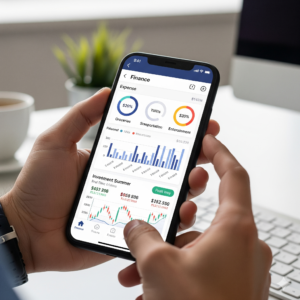
This is arguably the most important factor for a beginner. A professional day trader needs a platform with six monitor displays, complex charting tools, and streaming data feeds. A beginner needs a “Buy” button that is easy to find.
The “Gamified” App vs. The “Pro” Dashboard
-
The Modern App: Platforms like Robinhood or Webull popularized the “gamified” experience. They are incredibly easy to use, visually appealing, and make buying a stock as easy as ordering a pizza.
-
The Traditional Giant: Established brokers like Fidelity or Charles Schwab offer robust platforms. They might look a bit more “cluttered” or dated, but they offer significantly more data and research.
The Test: Download the mobile app of the broker you are considering. Is it intuitive? Can you find the “search” bar easily? If the interface confuses you, you will be less likely to invest.
4. Account Minimums and Fractional Shares

In the past, if you wanted to buy a share of a company like Amazon or Google, you needed thousands of dollars for a single share. This was a massive barrier to entry.
The Magic of Fractional Shares
For beginners with a small starting budget (e.g., $50 or $100), Fractional Shares are a non-negotiable feature.
This feature allows you to buy a slice of a stock based on a dollar amount, rather than the share price.
-
Example: You have $50. The stock costs $1,000.
-
With Fractional Shares: You buy 0.05 shares.
-
Without Fractional Shares: You cannot buy the stock at all.
Ensure your chosen broker supports fractional investing for both stocks and ETFs.
Minimum Deposits
Some brokers require $500 or $1,000 just to open an account. Look for brokers with $0 minimums. This allows you to start with whatever you have in your pocket right now.
5. Educational Resources and Research Tools
As a beginner, you are not just an investor; you are a student. The best brokers understand this and provide free educational content.
Look for a broker that offers:
-
Paper Trading: This is a “demo mode” where you can trade with fake money to practice without risk. This is an invaluable tool for the first month.
-
Screeners: Tools that help you filter stocks based on criteria (e.g., “Show me technology companies that pay dividends”).
-
Third-Party Research: Premium brokers often give you free access to research reports from Morningstar, CFRA, or Thomson Reuters. This professional analysis can help validate your investment ideas.
If a broker simply gives you a blank screen and says “Good luck,” it might not be the right place for a novice.
6. Asset Variety: What Can You Actually Buy?
Not all brokers sell everything. Your investment goals should dictate the platform you choose.
-
Stocks and ETFs: Every broker has these.
-
Mutual Funds: If you want to invest in specific mutual funds, you need a broker that offers a “No-Transaction-Fee” (NTF) marketplace.
-
Cryptocurrency: Many modern investors want a small exposure to Bitcoin or Ethereum. Some brokers (like Robinhood or SoFi) allow you to buy crypto alongside your stocks. Traditional brokers generally do not, forcing you to open a separate exchange account.
-
Bonds: If you are a conservative investor looking for fixed income, you need a full-service broker. Most “app-based” brokers do not offer easy access to the bond market.
7. Security and Regulation: Is My Money Safe?
In the digital age, security is paramount. You are trusting this company with your life savings. You must ensure they are legitimate.
SIPC Insurance
In the United States, legitimate brokers are members of the Securities Investor Protection Corporation (SIPC).
-
If the broker goes bankrupt (closes down), SIPC protects the securities in your account up to $500,000 (including a $250,000 limit for cash).
-
Note: This does not protect you from losing money if your stock picks go down. It only protects you if the broker itself steals your money or collapses.
Two-Factor Authentication (2FA)
Never sign up for a broker that does not offer strong 2FA (using an authenticator app or SMS). Financial accounts are prime targets for hackers.
Regulation
Check the footer of the broker’s website. You should see text saying they are regulated by FINRA and the SEC. If you cannot find this information, run away. It could be a scam or an unregulated offshore entity.
8. Customer Support: The lifeline You Hope You Don’t Need

You might think you don’t need customer service—until the app crashes during a market sell-off, or you forget your password, or a transfer gets stuck.
When that happens, how do you want to communicate?
-
Phone Support: Can you call a human being? Traditional brokers usually excel here, offering 24/7 phone lines.
-
Chatbots: Many newer apps rely heavily on automated chatbots and email tickets that take 24 hours to resolve.
Pro Tip: Before signing up, try calling their customer support number or opening a live chat. See how long it takes to get a response. If it takes 45 minutes to reach a human before you are a customer, it won’t get better after you give them your money.
9. The Alternative: Robo-Advisors vs. Self-Directed
Perhaps, after reading all this, you realize you don’t actually want to pick stocks. You just want your money to grow.
If you are terrified of choosing the wrong company, you might be better suited for a Robo-Advisor.
-
What is it? A platform (like Betterment or Wealthfront) that asks you a few questions about your age and risk tolerance.
-
What it does: It automatically builds a diversified portfolio of ETFs for you and manages it.
-
The Cost: They usually charge a small annual management fee (around 0.25%).
Many major brokerages now offer “Hybrid” models—you can have a self-directed account for your “fun money” and a Robo-Advisor for your serious retirement savings, all under one login.
10. The Deposit and Withdrawal Process
Liquidity is important. You need to know how easy it is to move money in and out.
-
ACH Transfers: This is the standard bank-to-broker link. It is usually free but takes 1–3 days.
-
Instant Deposits: Some brokers give you “instant buying power.” When you initiate a deposit, they lend you the money immediately so you can buy stocks right now, even before your cash arrives from the bank. This is a massive plus for catching market dips.
-
Debit Cards: Very few brokers allow you to fund via debit card, and those that do often charge a fee. Stick to bank transfers.
The “Best” Broker is the One You Use
There is no single “perfect” broker that wins every category.
-
Interactive Brokers is great for professionals but a nightmare for beginners.
-
Robinhood is amazing for ease of use but lacks deep research tools.
-
Fidelity/Schwab are incredible all-rounders but can feel overwhelming with options.
Your Action Plan
-
Be Honest About Your Style: Are you an active learner who wants to pick stocks, or do you want to automate everything?
-
Prioritize Low Costs: Ensure there are no annual fees and $0 commissions.
-
Check for Fractional Shares: This is essential for starting small.
-
Test the App: Download it. If you like the look and feel, you are more likely to engage with your finances.
The most important step is not finding the broker with the coolest logo; it is funding the account. Compound interest needs time to work its magic. The sooner you choose a partner and make that first deposit, the sooner your wealth-building journey begins. Don’t let “analysis paralysis” stop you—pick a reputable broker today and buy your first share of the future.