As we step into 2026, the financial landscape is evolving faster than ever. With shifting interest rates, a dynamic housing market, and the rise of new digital investment frontiers, simply “saving money” is no longer enough. To truly thrive, you need a high-definition roadmap.
Setting financial goals isn’t about restriction; it’s about direction. It is the process of deciding what you want your life to look like and then giving your dollars the instructions to build that reality. Whether you want to buy your first home, erase your student debt, or retire early, 2026 is the year to move from dreaming to doing.
In this comprehensive guide, we will break down the science of goal setting, the mechanics of the 2026 economy, and a step-by-step blueprint to ensure you finish the year wealthier and more confident than you started.
The Psychology of Success: Why Smart Financial Goals Work

Before we get into the numbers, we have to talk about the “why.” Most New Year’s resolutions fail by February because they are vague desires rather than structured goals. To succeed in 2026, you must utilize the S.M.A.R.T. Goal Framework.
Specific, Measurable, and Achievable
A goal like “I want to save more money” is too soft. Your brain doesn’t know what to do with that. Instead, try: “I will save $10,000 for a down payment by December 31st.”
-
Specific: You know exactly what the money is for.
-
Measurable: You can track your progress every month.
-
Achievable: It is based on your actual income and expenses.
Relevant and Time-Bound
Your goals must matter to you, not just look good on paper. If you don’t care about owning a home, don’t make it a goal. Finally, every goal needs a deadline. Without a “Time-Bound” element, there is no sense of urgency, and “someday” becomes “never.”
Assessing Your Starting Point: The 2026 Financial Audit
You cannot navigate to a destination if you don’t know your current coordinates. Your first task for 2026 is a “Deep Dive” audit of your 2025 performance.
Calculating Your Net Worth
Your Net Worth is your financial “GPA.” It is the total of everything you own (Assets) minus everything you owe (Liabilities).
-
Assets: Cash, retirement accounts, home equity, car value.
-
Liabilities: Credit card debt, student loans, mortgage, personal loans.
In 2026, the goal isn’t just to “make more money”—it’s to increase your net worth.
Identifying “Budget Leaks”
Review your bank statements from the last quarter of 2025. Look for “zombie subscriptions” (services you pay for but don’t use) and the “convenience tax” (excessive food delivery fees). Identifying these leaks provides the initial capital to fund your new 2026 goals.
Strategic Debt Reduction: Clearing the Path for Growth
For many, 2026 will be the year of “Debt Freedom.” High-interest debt is like an anchor; it doesn’t matter how hard you row the boat if the anchor is still on the ocean floor.
The Debt Avalanche Method
If you are driven by mathematics, the Debt Avalanche is your best bet. You list your debts by interest rate and attack the one with the highest rate first while paying the minimums on the rest. This saves you the most money in interest charges over the course of 2026.
The Debt Snowball Method
If you need psychological wins, use the Debt Snowball. Pay off your smallest balance first. The dopamine hit of seeing a debt vanish completely provides the momentum needed to tackle larger balances later in the year.
Building a “Fortress” Emergency Fund for an Unpredictable Year
If the last few years have taught us anything, it’s that the unexpected is the only thing we can count on. An emergency fund is not “savings”—it is insurance for your life.
The 3-6 Month Rule
In 2026, aim for a minimum of three to six months of essential living expenses (rent, food, utilities, insurance) in a High-Yield Savings Account (HYSA).
Why a High-Yield Savings Account (HYSA)?
With interest rates still being a major factor in 2026, leaving your emergency fund in a traditional checking account is leaving money on the table. An HYSA ensures your “security blanket” is actually growing while it sits there, helping you combat inflation.
Investing for 2026: Making Your Money Work as Hard as You Do
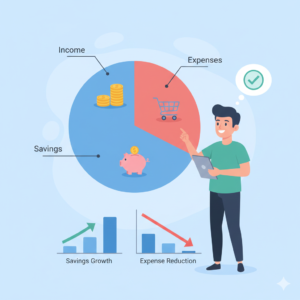
Once your debt is managed and your emergency fund is set, it’s time to move from “Defense” to “Offense.”
Maximizing Tax-Advantaged Accounts
In the United States, your first stop should always be accounts that offer tax benefits:
-
401(k) / 403(b): If your employer offers a match, contribute at least enough to get the full match. It is a 100% return on your money instantly.
-
Roth IRA: In 2026, the contribution limits may have adjusted. Aim to max this out. Since you pay taxes on the way in, your withdrawals in retirement are tax-free.
-
HSA (Health Savings Account): Often overlooked, the HSA is a “Triple Tax Advantage” tool. Contributions are tax-deductible, growth is tax-free, and withdrawals for medical expenses are tax-free.
Low-Cost Index Funds and ETFs
You don’t need to be a stock-market guru. For 2026, focus on “Broad Market” Index funds (like those tracking the S&P 500). These funds allow you to own a piece of the 500 largest companies, providing diversification and steady growth without the stress of “day trading.”
Mastering the “Sinking Funds” Technique for Major 2026 Purchases
Do you plan on taking a vacation in the summer of 2026? Or buying a new car in November? Don’t wait until the month of the purchase to find the money.
What is a Sinking Fund?
A sinking fund is a way to save for a specific, non-emergency expense. You take the total cost and divide it by the number of months until the purchase.
-
Example: $3,000 vacation in 10 months = $300/month in a dedicated “Vacation” bucket.
This prevents you from dipping into your emergency fund or, worse, putting the expense on a credit card.
Automation: The “Secret Sauce” of Successful Millionaires
The biggest enemy of financial success is human friction. If you have to manually move money into your savings every month, eventually, you will forget—or you’ll talk yourself into spending it.
“Pay Yourself First”
Set up your payroll so that a portion of your check goes directly to your savings and investment accounts before it hits your spending account. If you never see the money, you won’t miss it. This is the single most effective habit for building wealth in 2026.
The Role of Credit Scores in Your 2026 Strategy
Your credit score is your “financial reputation.” A higher score means lower interest rates, which can save you hundreds of thousands of dollars over a lifetime.
How to Boost Your Score This Year
-
Payment History (35%): Set every bill to autopay. One late payment can tank your score.
-
Credit Utilization (30%): Keep your balances below 10% of your total limit.
-
Credit Age: Don’t close your oldest accounts, even if you don’t use them often.
Staying Consistent When the Motivation Fades

Setting financial goals for 2026 is the easy part. The hard part is the “boring middle”—the months of February through October when the initial excitement has worn off.
Remember: Discipline is doing what needs to be done, even when you don’t feel like doing it. Check in on your goals once a month, adjust your budget as needed, and celebrate your wins, no matter how small. 2026 can be the year you finally take absolute control of your financial destiny.